21.04.2026 UPDATE – Xazal Mawalan was murdered by Iran (like so many others)
Iran continues its attacks on Rojhilat forces in South Kurdistan. Three female Peshmerga fighters were killed in rocket and drone attacks on PDKI facilities. Xazal is one of them; she died from her injuries due to a lack of medical care. The Kurdish Women’s Movement (KJK) strongly condemned the attacks and placed them in a broader political context. In a statement, the Kurdish Women’s Movement linked these attacks to a more widespread system of violence against Kurds and women. It is emphasized that the attacked forces had not carried out any military actions against Iran and that the attacks are therefore seen as a targeted strategy against the political existence of Kurdish structures.
April the 8th: Iran and the USA agree on a two-week ceasefire
Iran’s demands were the withdrawal of all US troops from the region, the lifting of all sanctions, and reparations payments to Iran. In return, the opening of the Strait of Hormuz was to be implemented, to which the Iranian Foreign Minister also agreed. Further developments show that attacks, primarily on oil facilities and power plants, continue. Israel agreed to the ceasefire but continues to attack Lebanon. Iran, however, will not open the strait as long as Israel remains at war with Lebanon: if it is opened, Iran demands a toll for all passing ships. Germany wants to participate in military operations in the Strait of Hormuz after a possible peace agreement. The US wants to independently impose a naval blockade to stop ships passing through with Iranian permission.
Anfal campaign
In 1987/88, the Iraqi regime (Saddam Hussein) conducted military operations specifically targeting the Kurdish people. Villages were besieged, men were separated from women and children from their families, and arson, mass arrests, executions, and genocide ensued. The use of chemical weapons, such as in Halabja (March 1988), resulted in long-term illnesses. A total of 180,000 Kurds were killed or disappeared, and hundreds of thousands were displaced. These genocides were led by Ali Hassan al-Majid, an expert in the use of chemical weapons. The underlying reasons included the exercise of control and power, the Iran-Iraq War, collective punishment, and the Arabization of strategic parts of Kirkuk province. Commemorative events were organized in various cities on April 14th.
The Red Wednesday
The first Wednesday in April is celebrated as New Year’s Day by the Yazidis. On this day, spring, the awakening of nature, and renewal are celebrated. The angel Melek Taus is also said to have created the earth and made it habitable for humans. Poppies (Kulîka Nîsanê – the flower of April) are a symbol of the New Year festival, and their blossoms are used to decorate houses. It is customary not to marry in April, as the month is considered sacred and is also known as Bûka Salê (the bride of the year). It is a month in which only the gods marry. Çarşema Sor is not only a traditionally important day for the Yazidis, but also expresses the Yazidi identity and their long struggle to defend it.
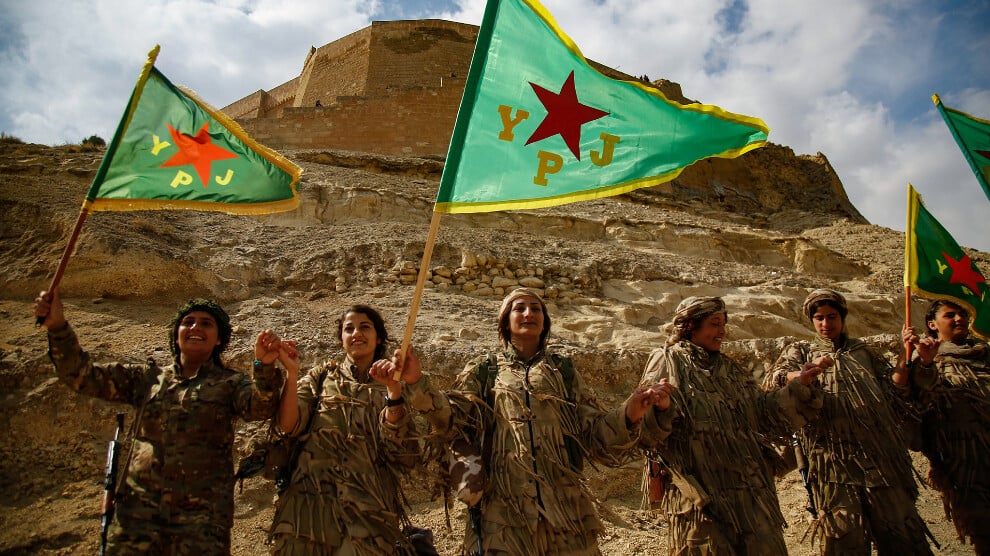
14TH ANNIVERSARY OF THE FOUNDING OF YPJ
On April 4th, a large military parade of the YPJ will take place in Qamishli, celebrating their 14th anniversary and expressing their stance on the demands of the current phase. The continued existence of the YPJ, integrated into the Syrian army but with the assurance of the autonomy of the women’s unit, remains their red line, as also expressed in the YPJ statement of April 3rd. In this context, the YPJ command in Damascus has held talks with the Ministry of Defense. The integration of the YPJ into the army is of historical significance for building a free and equal future in Syria. Since their founding, the YPJ have been built up step by step through a difficult struggle, great sacrifices, and heavy losses, thus achieving their current strength.
WORDLWIDE ACTIONS TO MARK ABDULLAH ÖCALAN’S BIRTHDAY
In Europe, Canada, the Middle East, and in the mountains, numerous celebrations and events took place on April 4th, the 77th birthday of Abdullah Öcalan. These events served both as cultural celebrations and as clear political demands for Öcalan’s release and a peaceful and democratic integration process. Öcalan’s birth was simultaneously celebrated as a historical turning point and as the birthday of all women. The events were met with police crackdowns, particularly in Turkey, culminating in the arrest in Istanbul of Sebahat Tuncel, an activist with the Kurdish women’s movement TJA and a former member of parliament.
REPEATED EXECUTIONS IN IRAN
Following the protests against the Iranian regime earlier this year, numerous trials have begun, particularly against Kurds, women, and young people, increasingly resulting in executions. In recent days, four young men — Ali Fahim, Mohammad Amin Biglari, Shahin Vahedparast Kaloor, and Amirhossein Hatami — were executed under the same legal system. Human rights organizations believe that the Islamic Republic uses these inhumane methods of extermination to maintain its survival. According to the human rights network HRANA, more than 2,000 people were executed last year—the highest number in decades.
AGAINST EXPROPRIATION AND ENVIRONMENTAL DESTRUCTION
Esra Işık was arrested in the Turkish province of Muğla for her activism against the exploitation of agricultural land and, in particular, for the protection of the Akbelen Forest near Milas. The expansion of open-pit mining is causing massive ecological damage and necessitates the relocation of neighboring villages. Protests in the Akbelen Forest and resistance against coal mining have been ongoing since 2021, but often result in the activists facing severe criminalization. The court has now rejected her appeal against her pre-trial detention.
SECOND CONVOY RETURNING TO AFRIN
Following the agreement between the SDF and the Syrian transitional regime, the second convoy departed from Qamishlo to Afrin on the morning of April 4th. This convoy includes 200 families, primarily from the Raco district and the city center of Afrin.
“No one abandoned their cause or left their land”
Interview of Riseup4Rojava with Heval Mehmed, March 2026
At the beginning of 2026, the hegemonic forces once again gathered and attempted to crush the Rojava revolution through a large-scale attack. In Rojava, a general mobilization was declared to defend the achievements of the revolution, and the society of Rojava rose up. Especially youths from all parts of Kurdistan and from Europe answered the general mobilization and joined the defence of the revolution. Rojava once again wrote/continued its history of resistance, and through collective effort and sacrifice, the attacks were stopped. The people who came from outside to participate in the struggle gave the resistance a lot of strength, and one of the young people who came from Northern Kurdistan (Turkey) is Heval Mehmed. Heval Mehmed, can you introduce yourself and tell us why you came to Rojava?
My name is Mehmed and I am twenty-two years old. I was born and raised in Northern Kurdistan, where I learned about the struggle of the PKK and Abdullah Öcalan when I was 18. Later, with 22, I joined the revolution to participate in the general mobilization for Rojava. When I was in North Kurdistan, I was greatly influenced by Şehîd Rojger Hêlîn and Şehîd Asya Alî¹. I had wanted to join the revolution before, but due to some problems, I didn’t get the chance, so I didn’t make the decision to join until I was confident in myself. When the mobilization was announced, I was uneasy while seeing the videos from Rojava. So this time, I made a firm decision to join and came to Rojava (West Kurdistan). When you see the videos that show what is happening in Rojava while you are in the North of Kurdistan, the media makes it look like there is no life there. But when I experienced life in Rojava, I realized that there is a really unique life here, and the people of this land are self-confident and can do anything to protect their country. If the time comes, they can even give their lives for their country.
The strategy for defending Rojava is the strategy of people’s revolutionary war. You, as a young person, were also influenced and headed to Rojava. What does revolutionary people’s war mean to you?
I had never seen a people so strong before. When I came here, I realized that, no matter how much you try to put it into words, you cannot describe what you are witnessing here. The world has never seen anything like this. Rojava is showing its struggle and its resistance through revolutionary people’s war to the world and is continuously taking a very important place in history. For its defense, everyone, from children to the elderly, took night shifts in the street. Everyone wanted to do something for their country. Many martyrs shed their blood on this path, and the morale of the martyrs’ families always stayed strong and determined. No one abandoned their cause or left their land. When I went to the martyrs’ ceremony, I witnessed that among the friends who were martyred there were also Arab martyrs, and the people who were attending the commemoration were all one and united in their hearts. There is some propaganda that wants to frame this war as an Arab-Kurdish conflict, but that effort failed. Once again, we renewed our belief in a democratic nation and the brotherhood of peoples, and we know that if we unite against the enemy’s racist propaganda and attacks, we can build a socialist and equal society and live together.
How did you come to Rojava?
I crossed from North Kurdistan to Rojava and the journey was very difficult. I was also wounded, but when I arrived here, the people of Rojava welcomed me warmly, and I forgot all my wounds. In my mind there was only the struggle for freedom and the defense of the country. Before I came here from Northern Kurdistan, I thought there would be some differences in language and culture, but when I arrived, all my assumptions disappeared. I realized that the only borders between us are artificial and have been created to divide us.
With the resistance of the people inside and outside of Rojava a ceasefire agreement was finally reached. According to this agreement several institutions are being integrated into the state. Outside of Rojava there are people who fear that the Rojava revolution will slip out of our hands. What would you say to them?
We live like the people did before, with only the institutions and army being connected to the Syrian state. Our achievements will not be taken away. For the terms of the agreement we want the Syrian state to recognize the YPJ and our languages and to accept our schools and our institutions. We will not give up the gains we have made with the blood of thousands of martyrs. We always want peace and equality to prevail, for all peoples to live freely and never to live under oppression.
The Rojava revolution has faced a very difficult war, and there is still the possibility of attacks by jihadist gangs. In this situation, what does peace mean to you?
I can say that if Abdullah Öcalan had not stopped this war, a very bloody and painful genocide would have been committed against our people, and many innocent people would have died. It would have reached the point of turning into an Arab-Kurdish war and fulfilling the desires of the enemies who are backed by hegemonic and imperialist states. Therefore, we must protect our achievements through peace. To build a communal and free life after the latest phase of war we must strengthen our organization, organize the people, and raise everyone’s morale. That is why we cannot allow deceiving propaganda to create confusion among the people. Instead, we all must place our trust in Abdullah Öcalan. To ensure that this process continues successfully, we are obliged to struggle even harder. The possibility of attacks by gangs still exists, so the people are still on guard, taking nightshifts in the street. From the youth to the elderly, everyone is prepared for defense.
The Rojava revolution, as a women’s revolution, also stands against the patriarchy of the surrounding regimes and has become an example for the entire world. How do you see the struggle of the Rojava women’s movement in this process?
The enemy now fears the braids of women and tries to erase the achievements of the women’s revolution, but as apoists we will not allow the enemy to attack the women’s revolution because the freedom of women is our red line. Abdullah Öcalan has worked very hard on this issue. When the Arab cities were attacked and fell into enemy hands, we saw how the symbols of women’s freedom were again destroyed. In Raqqa the statue of a YPJ fighter was demolished, and the whole world saw how men took to the streets and chanted slogans against the revolution. At that moment it became clear that this was not a war between the Kurdish and Arab peoples but in fact a war imposed by the patriarchal system on the women’s revolution. The women’s movement responded with the strongest possible response, taking an unbelievably determined spirit against the attacks like the martyr Denîz Çiya, who fought to the end as a sniper in Aleppo, or the mothers of the front-line villages who prepared food for the fighters. We know that in the cities taken by HTS, women are living in a very difficult situation. Therefore, we must insist on women’s liberation and Jineology to combat patriarchy and, in this way, strengthen our struggle in this area and never be at ease.
Today we see that war is escalating all over the world. Women, youth, and oppressed peoples are being targeted. As in Rojava, where the majority of those who joined the revolution and defended their land were young people, we see that youth everywhere are rising up against this war. What is your call to all the youth?
We see that in every war, women, children, and young people suffer the most and are the most affected by it. All forms of war are a great danger to humanity and harm the entire world. We must insist on peace against war and always put humanity first. My call to all young people is to strive not to become advocates of war but instead struggle for peace. We have to come forward to oppose the hegemonic plans of the dominant powers. For the brotherhood and sisterhood of the peoples and world peace, we need to deepen our understanding and knowledge of socialism and the line of women’s freedom. Our goal always has to be based on these principles: We will never lose hope, we will always act with moral and faith in our cause, and we will always strive for a free life. I wish success to all socialist comrades and those who insist on peace. Revolutionary greetings and respect!
1) Şehîd is Kurdish for martyr. The two martyrs conducted a guerrilla action on the 23rd of October 2023 and attacked the weapon and drone factory TUSAŞ in Ankara. They killed dozens of soldiers and held their position more then one hour inside of the factory. Through their action they became symbols for urban guerrilla of the 21st century.
27.03.2026 UPDATE – Resistance was celebrated with Newroz
Around the 21st of March the Kurdish festivity of Newroz was celebrated in all parts of Kurdistan, all cities of Rojava and in Europe. Eventhough in Turkey dozens of people got detained in the celebrations, the people celebrated Newroz under the slogan of “Freedom for Abdullah Öcalan”. Newroz, which celebrates the successful liberation of the people from the despotic empire of Assur 2600 years ago, was today celebrated again in Afrin as well as the neighborhoods Sheikh Maqsoud and Ashrafiye. The success of the resistance against the war which was forced on Rojava this january was visible and expressed in all celebrations.
Jolani comes to Berlin
The head of the HTS Ahmed al Sharaa, also known as al Jolani, announced to visit Germany’s capital Berlin on monday the 30th, according to German newspapers. Protest is expected, especially to strengthen the defense of the achievements of the women’s revolution and YPJ.
New steps of integration
As a success of the negotiations following the ceasefire agreement 400 people, fighters and civilians, were released from the HTS prisons until now. Still around 600 people are hostage of the HTS, while their freedom is a main aspect of all further negotiations. Under the released YPJ fighters is also Narîn Axîn, a arab woman who gave a clear statement of resistance to her people when she was released: “Let your belief in yourselves be strong. During my captivity, some called me a ‘gift,’ but today we stand before you in our military uniforms, proud and strong.”
Furthermore the integration of the SDF into the Syrian state takes more shape, with Sîpan Hemo becoming the vice minister of defense with the responsibility of the Kurdish regions as well as Çiya Kobanê becoming the commander of the so called 60th division, which resembles the SDF. Since the status of the Women’s Defense Units YPJ is not official yet, the struggle for a status continues. Nevertheless the women’s revolution and thereby the YPJ continue to be the red line of the negotiations.
As another success of the negotiations the displaced people of Afrin continue to return to their land in an organized way. While there are no Turkish troops in Afrin anymore,the people are still facing the racist attacks of arabic settlers.
Regime violence in Suweida
The violence of armed groups connected to the HTS continues in the city of Suweida in the South of Syria, where heavy weapons have been used to attack the city and Druse people have even been kidnapped and taken hostage by the regime forces. The administration and armed forces of Suweida take inspiration from the revolution of Rojava and even announced its women’s army less than one year ago.
16.03.2026 UPDATE- French ISIS Fighter on Trial
The trial of French citizen Sabri Essid, who joined ISIS and is charged with crimes against humanity and participation in the genocide against the Yazidis in Shengal, began today. It is the first trial related to the genocide in France and against a French citizen and highlights how little responsibility European states are actually taking in the fight against ISIS. The defendant is charged with trafficking and enslaving Yazidi women. To this day, European states in particular refuse to take back foreign ISIS fighters. Today, Shengal is again under the threat of genocide, since not just ISIS is reorganizing itself, but also the regimes of Iraq and Turkey try to attack the Yazidis and their self-organization and self-defence.
PJAK Statement
The co-chair of PJAK, a party part of the Kurdish freedom movement in Iran, spoke out in an interview. Amir Karimi: “We are ready to defend our people.” At the same time, he emphasized that there are no talks between the Kurdish parties and the U.S. The largest Kurdish parties in Iran recently united to form a political alliance that also expressed its “readiness to build a free, democratic, and pluralistic Iran.” None of the parties is participating in military attacks against the regime so as not to become a pawn of the U.S. and Israel.
Commemorating the Genocide in Halabja
Today, in Qamishlo, Tirbespî, and Heseke, the victims of Operation Anfal were commemorated. On March 16, 1988, Saddam Hussein’s regime dropped poison gas on the southern Kurdish city. In response to Kurdish militias taking control of the city the day before, the regime murdered many thousands of Kurds. The components of the poison gas were supplied from Germany. German companies and authorities denied responsibility, claiming they had not known that the components would be used for poison gas. The complicity of the German state in the genocide and attacks on the Kurdish people continues until today.
12.03.2026 UPDATE- Bids farewell to comrade Salih Muslim
Salih Muslim, a leading member of the Democratic Union Party (PYD), died on March 11, 2026, in Erbil, where he had been receiving treatment for sickness. He was a pioneer of the Rojava Revolution and twice co-chair of the PYD, playing a crucial role in the process of building a democratic Syria. During the 40 years he was involved in the revolution, he was arrested and exiled several times by the Baath regime and is also the father of a martyr. His remains were brought from Erbil to Rojava where they were welcomed by the society and will be buried there.
Appeal to the German government for Eva Maria Michelmann
The missing journalist Ahmed Polat had also conducted an interview with Salih Muslim earlier. In a press conference in Cologne, the family of Eva Maria Michelmann appealed to the German government to highlight the situation of the missing journalist. The two journalists were abducted and disappeared on January 18 during clashes over control of the city of Raqqa. There is still no information about their whereabouts.
Families return to Afrin
The first groups of families are returning to Afrin after years of forced displacement. Around 400 families have arrived so far from regions such as Heseke, Raqqa and Tebqa, and the return was welcomed by representatives of the Autonomous Administration. The first convoy was accompanied by Asayîş forces, while more families are preparing to return in the coming days as part of the implementation of the January 29 agreement. However, the return of a second group scheduled for these days has been postponed.
Al-Sharaa affiliated groups accused of looting
There are reported cases of looting at health centers and destruction of civilian property in the surroundings of Kobanê. In some cases, arson attacks against houses have also been recorded. Local sources report that armed groups affiliated with the self-proclaimed transitional government are responsible for the attacks on civilian property. Similar reports of looting of homes have also been documented in occupied Serekaniye.
Developments in North and East Syria
Traffic has resumed on parts of the international M4 highway, an important transport route in North and East Syria. At the same time, families in Kobanê have demanded the release of prisoners of war and the return of the bodies of fallen fighters. The Syrian Democratic Forces also announced that Sipan Hemo has officially begun his duty as Syria’s Deputy Minister of Defense. In Raqqa, the Women’s Protection Units (YPJ) also announced the martyrdom of one of their fighters.
Iranian army targets sites in Iraq
Military bases and airports in Iraq have been targeted by Iranian forces with missiles and drones. The attacks were directed towards Erbil and Nineveh, while a drone was intercepted near Baghdad International Airport. In a separate drone strike on a Komala base in Sulaymaniyah, a Peshmerga fighter was killed. The attacks come amid ongoing tensions between Iran and opposition groups based in the Kurdistan Region.
Two Kurdish prisoners start hunger strike
The Kurdistan Human Rights Network stated that retired teacher Mehdi Baqiri and activist Keyo Mers Waizi, held in Dizlawa Prison in Kermanshah (Iran), started a hunger strike four days ago. They were arrested during protests against the government in January and are now facing charges such as “propaganda against the state” and “disrupting national security.” According to the report, their protest is directed against political interference by the Ministry of Intelligence in their legal case. Meanwhile, human rights organizations warn that the conditions of women prisoners in Qarchak prison are worsening.
09.03.2026 UPDATE – 8th of March in Rojava
In all major cities of Rojava and even in some villages, March 8 was celebrated as a day of struggle and resistance for women in Kurdistan and around the world. With demonstrations such as those in the besieged city of Kobanê, with rallies, dances, celebrations, and slogans, the women of Rojava made it clear: The “Jin, Jiyan, Azadî” revolution lives on and continues to fight! Opposing them is the jihadist regime in Damascus, which is why the struggle for the release of the hostages still being held captive was also visible in all cities.
Return to Afrin
As negotiated in the ceasefire agreement of January 29, which came about under pressure from Abdullah Öcalan, the first families are returning to their homeland of Afrin in an organized manner. This morning, the first convoy of nearly 2,000 people who had fled to the regions of Heseke and Qamishlo set off for Afrin. Up to 40,000 people could return to Afrin next week. The return of the displaced persons to all areas of Rojava is a huge success of the agreement and the result of the resistance against the attacks in January.
02.03.2026 UPDATE – German journalist captured by HTS
Journalists Eva Maria Michelmann (German citizen) and Ahmed Polad have been missing since January 18. Both were in Raqqa to report on the attacks by HTS and their war crimes. While the jihadist fighters were taking the city, the journalists apparently fell into the hands of the jihadists. The fate of the two, as well as hundreds of others, is unknown, and it is unclear whether they are still in HTS captivity or have been executed. In Germany in particular, pressure is now needed to implement a long-demanded prisoner exchange in Syria and to uncover the war crimes.
War of the rulers
The attacks by the US and Israel on Iran and Iran’s counterstrikes in the Middle East continue. While the Iranian state has been severely weakened, it is clear that it is primarily the local population that is suffering from the attacks. For example, more than 148 girls were killed in an Israeli air strike on a girls’ school in Iran. Meanwhile, the Iranian military is transferring prisoners from Evin Prison, where many activists have been sentenced to death in the last time, to military bases to use them as human shields. In addition, Iran also attacked various Kurdish opposition parties that have their offices in Iraqi Kurdistan. Some Kurdish parties in Iran announced their political unity just a few days ago. Neither the current mullah regime nor the Shah, whom the US may want to install, give society room to breathe. The only solution is unity among all social forces against the hegemonic powers.
Women demonstrate in Kobanê for YPJ
In the city of Kobanê, which is under siege by HTS, the women’s movement organized a demonstration to express their support for the Women’s Defense Units (YPJ). The YPJ are the foundation of the revolution in Rojava and are therefore repeatedly targeted by HTS in attempts to force them into negotiations. The demonstration made it clear once again that the freedom of the women of Rojava is non-negotiable and that the Women’s Defense Units will remain in place.
28.02.2026 17.00 UPDATE Israel and USA attack Iran
This morning, Israel and the United States carried out a series of missile strikes on Iran in an operation dubbed “Roar of the Lion”. The cities hit so far are the capital Tehran, Isfahan, and Qom. Iran is currently responding to the Israeli and US military operations by striking the US naval base in Bahrain and launching missiles against Israel. The attacks come amid negotiations between Israel, the US and Iran to reach an agreement on the Islamic Republic of Iran’s nuclear arsenal. This violent twist in the negotiations, which will affect innocent civilians and slow down the agreements, will only lead to further instability in a region already affected by more than two years of Israeli attacks on neighbouring states.
New statement of Abdullah Öcalan
Exactly one year after his historic call for peace and a democratic society, the founder of the Kurdistan Freedom Movement Abdullah Öcalan has released a new statement from Imrali prison. Considering the latest intervention of Abdullah Öcalan which paused the war in Rojava and the rest of Kurdistan, the statement emphasises the fact that: “The process we have left behind has proven our negotiating capability and our strength to ensure the transition from the politics of violence and polarization to democratic politics and integration.”
Ilham Ehmed and Rohilat Efrîn in the European Parliament
This week, Ilham Ehmed and Rohilat Efrîn addressed MEPs at the European Parliament in Brussels.Not to ask for favours but to demand real guarantees for the Kurdish people.They spoke about the crisis in Syria. They reiterated that an international monitoring mechanism is needed to protect political, cultural and civil rights.They made it clear that no agreement with Syria can be fair unless it guarantees the dignity of the Kurdish people and all components of the region.This is not empty dialogue. It is a call for international responsibility. It is the voice of those who defended the people from ISIS, those who built freedom under fire, those who do not give up.
Çelebî: new joint checkpoints
In Çelebî, the town in the Kobanê area where heavy attacks by jihadist militias were taking place until a few weeks ago, where the offensive was stopped, joint checkpoints have now been set up as provided for in the 29 January agreement. The city of Kobanê has been under siege for more than 40 days, so the presence of joint checkpoints should not be seen as a sign that the state of emergency is over, but should still be considered part of the integration process.
Australian Government Statement on Aleppo
Australian Foreign Minister Penny Wong responded to a letter from Labour MP Charishma Kaliyanda regarding the Syrian interim government’s attacks on Kurdish forces. Australia says it is deeply concerned about the escalation of violence in Aleppo, the clashes between Kurdish forces and the interim government, the civilian casualties and the forced displacement of people. Canberra calls for compliance with the ceasefire and supports an inclusive political transition that guarantees the rights of all peoples in Syria. Australia says it has raised these concerns through diplomatic channels and is co-sponsoring a UN resolution for the protection of civilians. Since 2011, more than $600 million in humanitarian aid has been provided to Syria and neighbouring countries.
26.02.2026, 18:00 CET UPDATE – Hostage families call for action to ask the liberation of hostages
Yesterday in the city of Qamishlo hundreds of family members of SDF fighters detained in the prisons of the jihadist regime demonstrated to ask their liberation. ANHA’s agency reported the words of one of the protesters, Youssef Kouti: “We stand now before the United Nations headquarters, which has not fulfilled its role or duty toward the peoples of the region, and before our people whose blood has been shed, who have sacrificed their lives and whose hearts have burned with grief. We stand before a United Nations that ignores its own laws and principles. Since January 6, and since the treacherous attack by two states, with the support of the entire world, on the neighborhoods of Sheikh Maqsoud and Ashrafiye, followed by the extension of attacks to Dayr Hafir, Maskanah, Raqqa, and Tepqa, the Turkish state and the interim government and their cells have not adhered to the agreements and have placed our sons under a suffocating siege.”
Yazidi risk genocide again
12 years later the brutal genocide in the city on Shengal, there is the strong risk that this can happen again. The Iraqi army is stepping up its activities in the area, increasing the number of checkpoints within the city and demanding disarmament. For this reason, the people of Shengal have declared that they will not surrender their right to self-defence to anyone, as they are fully aware of this policy and its dangers. The internationalist solidarity is essential to prevent another genocide.
Syrian Interim governement’s military sites got target in Deir ez-Zor
It was reported by SOHR that armed men, probably affiliated with ISIS, targeted military and security positions belonging to the Syrian regime in the eastern Deir ez-Zor countryside. An un unidentified gunmen opened fire with machine guns on the headquarters of the 86th Division in the city of Albu Kamal. There are no information about any casualities or material damages. Another attack took place on a security center in the town of Sousa in the Eastern Deir-ez-Zor countryside.
The journalist Elah Mohammad has been arrested by iranian regime for the second time.
Local mediad sources stated that Elah Mohammad has been arrested in the last days without any official motivation given by the authorities or any formal charges.
Mohammad has been in prison for 17 months in 2022 after she was participating to a journalist investigation about the murder of the Kurdish young woman Jina Amini on Septemer 29, 2022.
This case is just one of hundreds of the arrests without reason that the Iranian regime does every year.