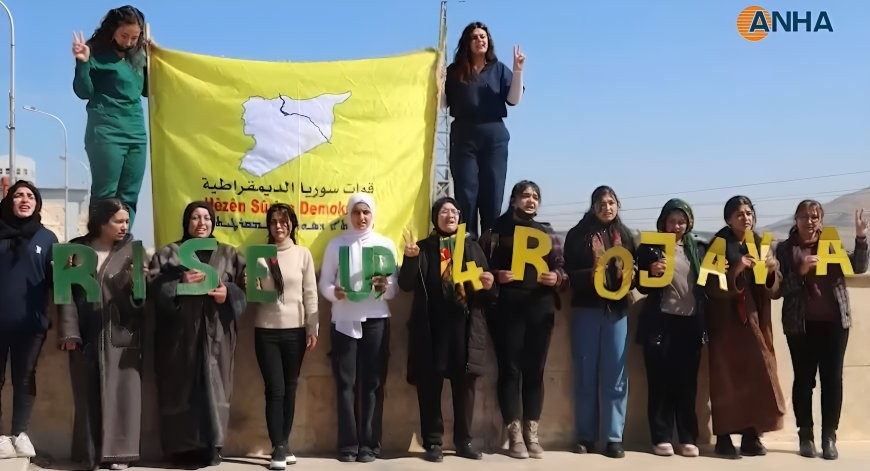
The Turkish backed islamist gangs declared war on the Kurdish people in Aleppo. With artillery and tanks they attacked the neighbourhoods of Sheikh Maqsoud and Ashrafiya. They attack the women’s revolution and the struggle for a democratic and socialist society, today taking place in Iran and Syria. Now Turkey and the islamists in Damacsus are threatening all of North- East Syria with war.
Right now it is crucial to act fast to stop the war. International pressure in the West is needed to support the people’s resistance in North- and East Syria.
We call all internationalists and everybody fighting for freedom to act and defend the revolution. We call for actions to build pressure in the streets and to proclaim with a loud voice: “We don’t accept any attack on the revolution of Rojava. We see the Turkish State behind these war crimes. We are united in the struggle. Long live the revolutionary people’s war! Defend the Rojava Revolution for a Democratic Syria!”
Red Lines and Opportunities: Overcoming war in Kurdistan
Analysis by Riseup4Rojava, 20.11.2025
Ten years have passed since the Turkish state broke the negotiation table with the Kurdish Freedom Movement and implemented a concept of war that aimed at the total destruction or surrender of the PKK and the Kurdish Freedom Movement. Despite immense repression, large scale military operations, and systematic efforts at annihilation, the Kurdish Freedom Movement has not been broken.
After a decade of intense war, a new political processes that holds the potential to reshape the future of Kurdistan and the Middle East has been started. Understanding this moment requires an overview of what has been achieved in the last months but also what has happened in the last 10 years, and what transformations are now underway.
A Decade of all-out War and Resistance
Since 2015, the Turkish state has carried out a comprehensive campaign to eliminate the Kurdish Freedom Movement. It aimed to crush political organization in Northern Kurdistan and Turkey, to occupy revolutionary territories in Rojava/North-East Syria, and to encircle and destroy the guerrilla in the mountains of Southern Kurdistan. Tens of thousands of activists, journalists, and politicians were imprisoned; and Turkey launched invasions into Northern Syria – Jarablus in 2016, Afrîn in 2018, and Girê Spî and Serêkanîyê in 2019. These attacks, along with continuous airstrikes and the occupation of parts of Southern Kurdistan, are part of the strategy of annihilation which the Turkish state used to call “The Kneefall plan”. Each year, the AKP-MHP regime in Ankara declared that victory was imminent, that the movement was on the verge of defeat. Yet after ten years of war, the facts are clear: Turkish fascism failed in its central goal. The movement has not been destroyed; Rojava has not fallen; and the guerrilla continue to hold their strongholds in the mountains. Despite mass arrests, torture, forced exile, and the displacement of millions, the revolutionary will of the people remains unbroken. In Northern Kurdistan and Turkey, a powerful political consciousness endures. In Rojava, the people have defended their revolution despite ten years of war, siege and embargo. The popular resistance during the battles at the Tishreen dam this year once again demonstrated that this revolution rests on the power of the people and their self-defense. The Assad regime relying on foreign powers, namely Russia and Iran was wiped away in only 12 days while the liberated territories in North-East Syria prevailed.
The Stalemate and its Meaning
In Southern Kurdistan (Iraq) the Turkish state has been able to occupy wide parts of the mountain areas and constructed close to 130 military posts and bases, some of them in important strategic positions. But they have not been able to break the resistance of the guerrilla. They have neither been able to enter into the military center of the guerrilla in Garê. Nor have they been able to enter the political center of the revolutionary movement in Qandîl. Eventually they have not been able to completely fulfill their plans in the mountains. The result is a military and political stalemate: the Turkish army cannot destroy the guerrilla, and the guerrilla cannot yet drive out the occupiers. Acknowledging the balance of forces, this stalemate is in itself a huge success. The Kurdish Freedom Movement, facing NATO’s second-largest army and the technological and financial power of the alliance behind it, remains undefeated. This outcome is a victory of the people’s will and of the international solidarity. In fact the last 10 years of war also pushed Turkey to its limits. The country’s economy is on the brink with inflation-rates going up to 80 percent. The country is more and more isolated and has diplomatic problems with many neighboring states and international powers because of the conflict and war with the Kurdish Freedom Movement. Even at home, the Turkish state is not anymore able to continue its policy of war as the society is rejecting it due to the economic crisis the war has caused. We can conclude that the Kurdish Freedom Movement has been able to force the Turkish state onto the negotiation table. This by itself is a success for the revolutionary movement and a defeat for the Turkish state.
Shifting Geopolitics of the Middle East
To understand the present phase, we must see it within the broader transformations reshaping the Middle East. The Middle East that we knew 10 years ago does not exist anymore. If we look at the geopolitical situation and general political conjuncture in the Middle East we can see another reason for the Turkish state to enter negotiations with Abdullah Öcalan and the Kurdish Freedom Movement. The Middle East is in this time undergoing profound changes to a historical extend which until now can not even completely be foreseen. Especially since the Israeli aggression from October 7th 2023 onward, the attacks on Lebanon, Syria, Iraq and Iran are changing the face of the Middle East.
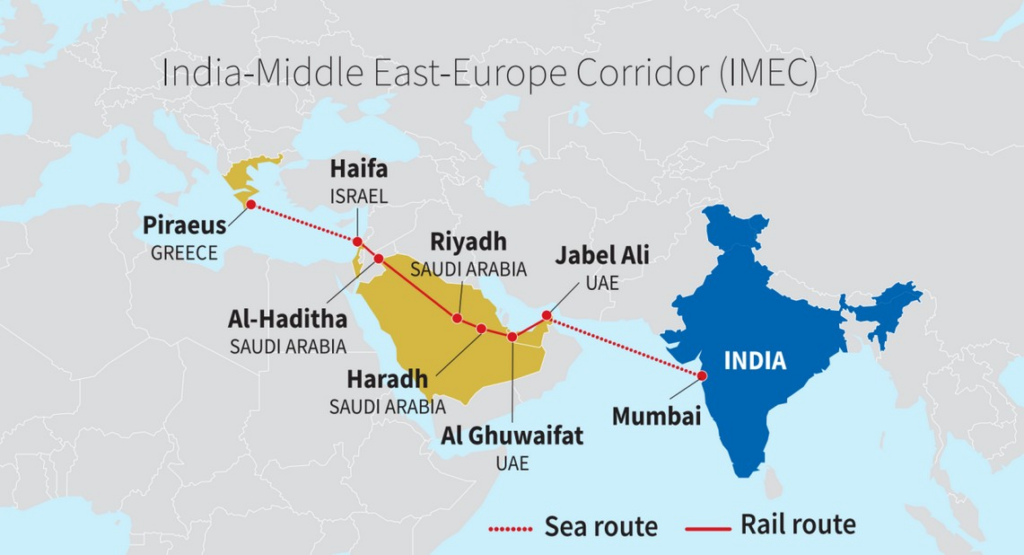
For decades, Turkey served as NATO’s southeastern flank – the alliance’s “gendarmerie” in the Middle East. Its geo-strategic location gave it leverage over Europe and the United States. However, the shifting patterns of global trade and power have begun to undermine that position. Modern global production depends on fast trade routes between Asia and Europe. When Russia’s 2022 invasion of Ukraine disrupted the northern transport corridor, Turkey hoped to become the key bridge between East and West. Yet the announcement of the India–Middle East–Europe Economic Corridor (IMEC) in 2023 changed the equation. The IMEC connects India to Europe via the United Arab Emirates, Israel, and Greece—bypassing Turkey entirely.
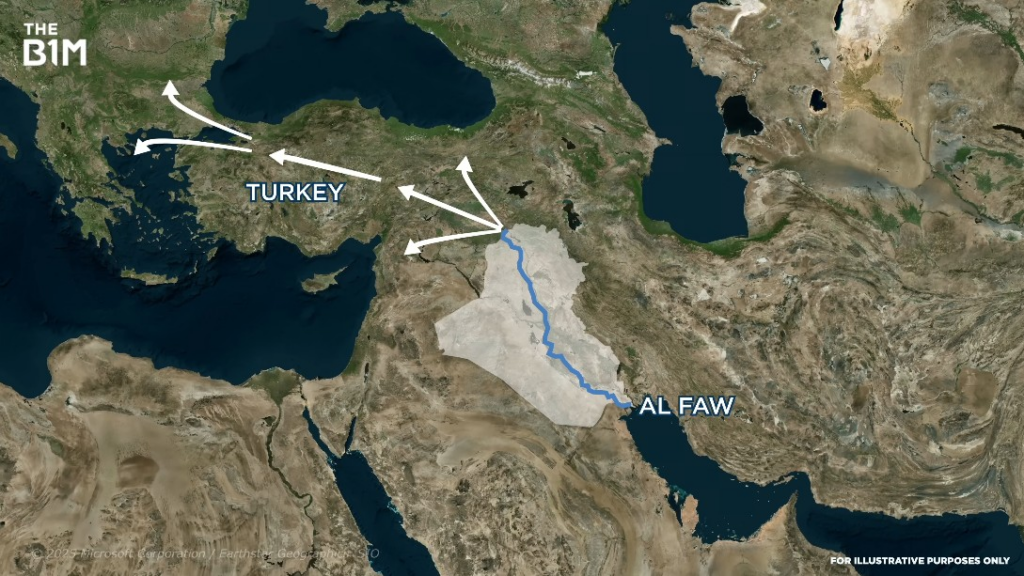
This project directly challenges Turkey’s long-standing ambition to be the central transit route between Asia and Europe. Ankara’s own “Iraq Development Road,” first proposed in 2010, would connect the “Al Faw Port” in the Southern Iraqi city Basra to the Turkish border and on to Europe. But instability caused by Turkey’s ongoing war in Kurdistan has made international investment impossible. The route passes through areas affected by clashes between Turkish forces and the Guerrilla – making the corridor too risky for global capital.
Unable to stabilize Kurdistan or solve the Kurdish question, Turkey has been pushed to the margins of new regional trade strategies. In contrast Israel, empowered through the Abraham Accords since 2020, has emerged as Washington’s primary regional partner. The USA now relies less on Turkey and increasingly on Israel to enforce its hegemony in the Middle East.
The Turkish state faced a dilemma: either confront US-Israeli plans directly, risking isolation, or submit to the new order. It is in this frame that Devlet Bahçeli, leader of Turkey’s fascist MHP, in October 2024 called on the leader of the Kurdish freedom movement, Abdullah Öcalan, to put an end to the armed struggle. Bahçeli was talking about the necessity to secure the “inner front” of Turkey, saying that “we are living in times in which Turkey is under heavy attacks from the outside”, thus making it essential to “secure the inner fortress”.
When taking the regime change in Syria into account this analysis shows to be true. Why did the Assad regime fall? Rather than promoting national unity grounded in equality, Assad built a repressive system dominated by a small ethnic minority which left them vulnerable to foreign intervention.
In the Middle East any kind of state that has not been able to create unity between the different nationalities, peoples and sects always had an open flank to foreign intervention, and Turkey also knows this. Yes, despite changes in rhetoric and small steps toward the Kurdish movement, Turkish fascism’s mentality remains unchanged. What happened is not an profound ideological change. The changed geopolitical situation and the fact that the Turkish state has not been able to break the resistance of the Kurdish Freedom Movement has forced it to the negotiation table. The Turkish states actions must be understood in this geopolitical context – not as signs of democratization, but as an attempt to consolidate the regime’s position under new global conditions. Even though the intentions of the Turkish state are not favoring democratization, the process may in the long run open up historical chances for the democratic forces inside of Turkey.
The Negotiation Process: Öcalan’s Initiative
In this climate of stalemate and shifting alliances, the call of Abdullah Öcalan on 27 February 2025 to dissolve the PKK and end the armed struggle marked a turning point. Öcalan’s call aimed not at surrender, but at opening a political path to transform the struggle under new conditions. The movement responded positively: on 1 March 2025, it declared a unilateral ceasefire, pledging to act only in self-defense. For months, Turkey ignored the initiative and continued military operations in the mountains of Zap, Metîna, and Avaşîn. Guerrilla units resisted ongoing airstrikes and ground assaults until July, when hostilities finally subsided. Since July 2025, the situation has remained relatively stable. It cannot be described as a genuine two-sided ceasefire, as there is no official agreement signed by the Turkish state. Nevertheless, direct clashes and airstrikes in the mountains have ceased. The Turkish army has instead focused on reinforcing its existing positions and rotating troops, while continuing reconnaissance operations with drones across the region. It must be clear that for the Turkish state, this is not a process aimed at peace or a genuine solution. Its goal is merely to reduce external pressure and buy time. The enemy remains the same – still intent on destroying the gains of the revolution and weakening the movement wherever possible. If given the opportunity, they will strike again. For this reason, the guerrilla forces have preserved all their defensive positions throughout Southern Kurdistan.
Rojava is a Red Line
The ceasefire, despite being one-sided, created space for new political dynamics. In Syria, Öcalan’s call provided the foundation for the 10th of March agreement between the Syrian Democratic Forces (SDF) and Hay’at Tahrir al-Sham (HTS), leading to a ceasefire on several frontlines. The later ceasefire around the Tishreen Dam in April 2025 was a direct outcome of negotiations influenced by the discussions between Öcalan and the Turkish state. Öcalan made clear that any political process must recognize the achievements of the Rojava Revolution. This was his red line during the earlier peace process of 2013–2015, and it remains so today. The revolution in North and East Syria, built on Democracy, Women’s Freedom and Ecology would never be sacrificed for temporary political gains.
Transformation, not Capitulation
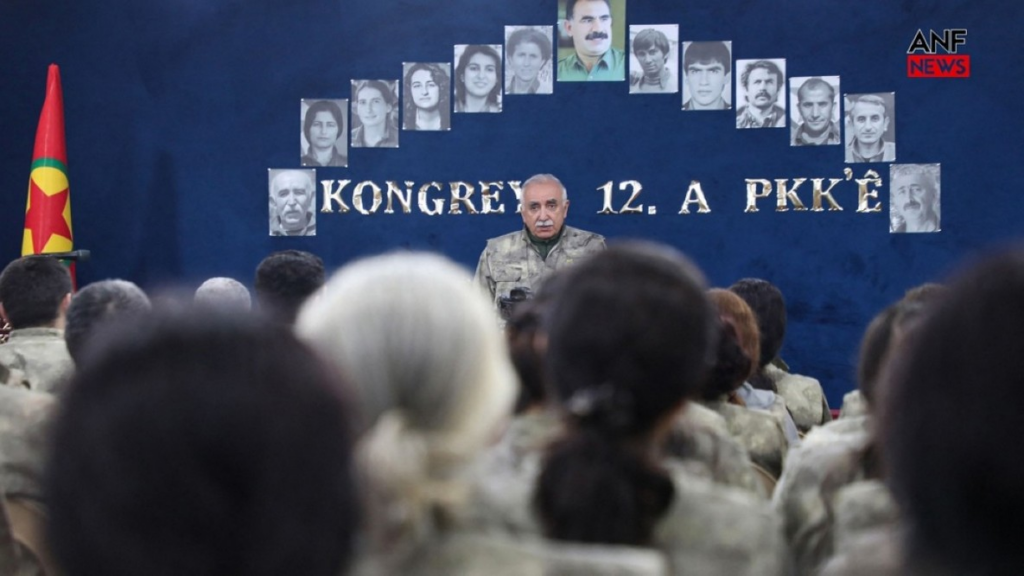
When the PKK’s 12th Congress announced the organization’s dissolution in mid-2025, it emphasized that this was not an end, but a transformation. The movement seeks to reorganize itself politically and ideologically, adapting its forms of struggle to the current realities and the Paradigm of Democratic Modernity.
After years of intense conflict, this phase allows the movement to regroup, analyze, and prepare strategically for the coming period. Many experienced cadres have fallen, and entire generations of militants have fought continuously without rest or space for reflection. The current process therefore serves both political, philosophical and organizational renewal.
The symbolic burning of weapons on 11th July 2025 expressed the movement’s commitment to peace and its moral strength. It demonstrated clearly that the desire for an end of the war comes from the revolutionary side, not from the state. Yet the Turkish regime has taken no meaningful steps in return. Öcalan remains in isolation on Imralı Island; no judicial or constitutional guarantees have been offered. Meanwhile Turkish officials continue to demand unconditional surrender. Under such circumstances, the guerrilla rightly maintain their defensive positions in the mountains.
On 26th October 2025, the movement announced the withdrawal of all guerrilla units from Turkish territory to the mountains of Southern Kurdistan. This step aims both to reduce the potential for provocation and to reinforce the political process. It is a tactical move to maintain initiative and push the strategy forward. The Turkish state has not given any kind of guarantees but is continuing to call for a surrender. Of course under these kind of conditions it is not possible for the guerrilla to step down from the mountains or to just lay down the weapons and give up onto self-defense.
Rojava and the Question of Self-Defense
In the current talks on integrating the self-defence forces of the SDF, of YPG and YPJ into the Syrian army, disarmament is not on the table. The SDF (Syrian Democratic Forces) may be integrated into the Syrian army, but that does not mean they are getting disarmed. Instead they need to be integrated as an own military faction into the Syrian army. As separate battalions they will continue to defend the same territories. This is clearly necessary. Talking about integration does not mean that forces of the Syrian regime, of the islamists, would patrol in the cities of Rojava, but it would be the defense forces of North and East Syria securing the achievements of the revolution. Regarding the topic of the Women’s Defense Units YPJ: they are one of the most important achievements of the revolution that the women have fought and given huge sacrifices for during the 13 years of Revolution in Rojava. Accordingly a disarmament or dissolution of the women’s army is indisputable. The new Syrian regime put this as one condition in front of the movement, but it is clear that an integration can just be successful if also the existence of the autonomous defense forces of the women will be accepted.
Given the massacres committed against Alawite, Druze, and other communities in Southern Syria, demanding disarmament would be political suicide. The self-defense forces of North and East Syria are a guarantee of survival and dignity, not a threat to peace. Any lasting solution must acknowledge their legitimacy and permanence.
Global Context and Internationalism
As the network of Riseup4Rojava we dedicated the last years to find strategies and tactics to spread and defend the achievements of the revolution that have been reached through an immense struggle. This also continues to be our task in the future.
Now there are a lot of discussion happening inside the movement about how to continue the struggle in an international frame. As stated before, the process is taking place on the background of profound geopolitical changes of the region. But these changes are not just taking place in the Middle East. We are in these moments experiencing a global offensive of US-Imperialism. In Abya Yala (South America) for example similar developments are taking place as have been seen in the Middle East. The global rise in confrontation between imperialist powers, between different states and between different capital factions are leading our world to war on a global scale. Today, on more and more front lines, war is breaking out openly. That is the direction in which not just the Middle East, but our whole world is steering to. This is also the reason for the European states in which we are living in to continue to increase the repression towards the inside. The rise of authoritarian states is the consequence of an increased global confrontation: The more the confrontation to the outside, the more it is necessary for them to secure the inner front. That is one reason why we see the rise of fascist movements inside our countries.
That is why the movement and Abdullah Öcalan have been underlining the necessity to increase the networking, the common struggle – of revolutionary forces, socialist movements, democratic and anti-fascist forces around the world. It is necessary to strengthen this unity and to focus on common struggles and enemies. If we cannot unite and fail to join forces now, the future we are facing will be grim. That is a reality.
In forging the unity among us, we have been making valuable experiences as the Riseup4Rojava network. It is important to put the focus on political unity, respecting ideological differences and contradictions as well as the difference that we may have in our practice. But to unite in the focus on common political goals and the common enemy will build revolutionary internationalism. In the political unity we find a solution and an answer, not just to the situation in Kurdistan, but also to the global situation that we are facing in these times.
For the movement this moment is critical because this process is also holding a lot of dangers. It is not set in stone where this process is heading to. When it was started in 2024, it was started by the initiative of Abdullah Öcalan and the movement joined in. From the start, it was unclear how this process would unfold, and arriving at today’s point is not the outcome of some kind of natural course. Thus, what is going to happen tomorrow is dependent on the struggle.
When we evaluate the political situation of Syria or what will happen next in Northern Kurdistan and Turkey or in Europe, we do not just think about what our enemies are going to do, but focus on what we and our allies can do and how we can strengthen the movement. In the last 10 years the movement has survived because of the support of the people and its strategy of revolutionary people’s war. It has survived because of the international mobilizations that have taken place.
What we are going to achieve in the future, we will achieve with struggle!
What we have achieved in the last 10 years we have achieved together. It was the people of Kurdistan, the people of Syria, the people of the Middle East that were fighting on the frontline, defending the revolution. As part of the global resistance movement we took up our task and became an important factor, creating the strength we needed for the achievements of the last ten years. Whatever has been achieved, was achieved through struggle. What we are going to win in the future, we will win with struggle. Therefore, even if it is not clear where the process is going to go, it is more than important to take a position as internationalists and revolutionary forces. It is important to develop new positions and strategies.
In the spirit of 21st century internationalism we call to join the global resistance movement, to defend the revolution of Rojava and Kurdistan and to join Riseup4Rojava!
We as internationalists in Rojava condemn the attacks on the people of Sweida by the jihadists of HTS and their allied gangs.
These attacks prove once again that HTS is not interested in protecting minorities. They do not want a democratic Syria. The so-called Syrian Transitional Government is not a government for the peoples of the region. They govern to build up a fundamentalist Islamist state to secure their own power.
We stand with all peoples in Syria. We stand against the massacres on the Alewi and Druzi people and the systematic kidnappings of women across all Syria.
We stand with the people as they resist all of HTS’s attacks and violence. As they fight for the alternative of a democratic Syria. For a Syria, where the people can live together in peace. This alternative exists today already. The Autonomous Administration of North East Syria practices self-administration, self-defense, ecology and women’s freedom and so presents a model for all of Syria and the Middle East.
As internationalists, we expose the complicity and hypocrisy of the Western states. They whitewash and hide HTS’s crimes and collaborate with these jihadists for their own interests.
We call on all our comrades to stand with the people’s of Syria and join us to strengthen their struggle.
Riseup4Rojava Network
12.08.2025
Right now the people of the city of Sweida are fighting to defend themselves in Syria. Sweida is a region in southern Syria where mostly Druze people live, which is a minority religious group. The leadership of the Druze people are calling for humanitarian corridors to evacuate people to areas of the Autonomous Administration and to Jordan. On July 13 forces allied with HTS began big attacks on the region and the people have resisted. This is just the latest phase of the jihadists in Damascus trying to secure their power. And again the international media tries to cover up their crimes.
We have seen many great tricks in the Middle East and today in Syria we see another. State leaders and their national media have transformed men once seen as Islamist fascists into respectable politicians. The US removed HTS from the terrorist list, took the $10 million bounty off al-Sharaa’s head and they became the “Syrian Transitional Government”. But make no mistake. These are the men of al-Nusra and ISIS. Men who murdered hundreds of civilians, raped hundreds of women, assassinated women leaders like Hevrîn Xelef, and sold women as sex slaves. And they have not changed. This diplomatic face of jihadism reflects a change in tactics, but the ideology remains: to impose Islam with violence for power.
Background
In 2016, al-Nusra split from al-Qaeda. It was dissolved when it joined with other jihadist groups to form Hay’at Tahrir al-Sham (“Organization for the Liberation of the Levant”). HTS declared itself on 28 January 2017, with Ahmed al-Sharaa (also known as al-Jolani) as its emir and overall military commander. With the support of the Turkish-backed SNA (Syrian National Army) HTS took control of Idlib in 2018, a city in north-western Syria, between Aleppo and Latakia. Here they established their “Syrian Salvation Government” under Islamic law.
In Idlib, Turkey’s support allowed HTS to keep control and gain experience in state building and governance. Attacks on women were a basis for this state building. They used both law and culture to erase them from public life and present house-bound care takers and mothers as the ideal woman. Women must be fully covered and can only be in public with a male guardian. Many women attend university in Idlib but they can only study religion and domestic skills and take jobs in women-only environments like girls schools and women’s health. Not all these restrictions are legal, but breaking any of them risks harassment, intimidation and arrest and openly protesting them is heavily punished.
With its strength from Idlib, HTS launched its offensive in November 2024 and overthrew the Assad regime. Videos and pictures from the beginning showed many HTS and SNA fighters carrying ISIS flags and wearing ISIS badges on their military uniform. When the Assad Regime fell, HTS suddenly started talking about a “Syria for all Syrians”. At the same time they created their new government.
Now
The project of this new government is clear in its leadership, constitution and actions. The proposed constitution declares Syria as an “Arab Republic”, with Islamic law as its legal system and Arabic as its official language. It also gives al-Sharaa dictatorial powers. For example, only he can appoint ministers and judges and there are no processes to challenge these decisions. For HTS, peoples who are not Sunni Muslims challenge the identity of their new Islamic Arab state. As in Idlib, the oppression of women is a basis for dealing with this problem.
A first step in their state-building was to give known jihadists, who are experienced at waging war on women, leadership roles in the government and military. Shadi al-Waysu was the first Minister for Justice. Before, he was a judge for al-Nusra. In 2015 videos of him sentencing women to death and supervising their executions spread online. When people protested al-Waysu’s appointment, HTS confirmed the videos were real but said these actions were in the past. Abu Hatem Shaqra, Sayf Boulad Abu Bakr, and Mohammed al-Jamma were all SNA members. When HTS formed the new Syrian army at the start of 2025, SNA dissolved itself into it. All three men are now commanders. Shaqra participated in the assassination of Hevrîn Xelef in 2019. He is now the commander of the SNA division operating in North and East Syria. Abu Bakr and al-Jamma led divisions of SNA. Both are famous for their own brutality and the atrocities their divisions committed in Afrin and Northern Syrian since 2018. Kidnapping, stealing, rape, murder, extortion, and torture were all weapons they used every day against the people. Abu Bakr’s divison was especially known for systematically kidnapping women to be sold as sex slaves.
These leaders are using a range of tactics to force Islam on the people. Religious fliers tell women how to cover themselves according to Islamic law. Segregation is being introduced, with men and women being separated in buses and bread lines. New laws and polices are then enforced with terror. With murder, kidnap, rape, ransom, humiliation, and torture they punish minority identities and those who challenge Islamic law. Assad, an Alewi, had his strongest support from other Alewi people. As a minority connected to the old regime they now face the most violence.
In March and April videos showing piles of bodies of Alewi people living on the Syrian coast flooded the internet. Civilians told stories of fighters coming to peoples homes asking them if they were Sunni or Alewi and then murdering them. Women were stripped naked and marched through the street before being shot. It was at this moment, on 13 March, that the HTS government decided to publish its proposed constitution. As women, men, and children are murdered, more and more women are being kidnapped and disappeared. Most of the women are Alewi and were kidnapped from coastal areas, most in broad daylight. Their families are then threatened to keep silent or forced to pay ransoms. At least 25 other women were kidnapped but have been released, most were raped. Some reappear wearing new Islamic clothes. Some with new Sunni husbands or fiances. Many women are being taken to Idlib and sold, others seem to have been taken out of Syria.
Zeinab Ghadir, who is 17, was kidnapped on her way to school. Doaa Abbas was dragged into a car outside of her own home. Both have disappeared. Mina and her sister were walking to the market when a car stopped them, asked “Are you Sunni or Alawite”. When they said Alawite the men forced them at gunpoint into the car. They reappeared two months later, left on the street at night, dressed in niqabs. One women was kidnapped during a doctors appointment and taken to Lebanon to be sold. She then escaped from the man who had bought her. Another woman was kidnapped and released with her head shaved and injuries all over her. Mira went missing and reappeared weeks later but she was wearing a blue jilbab and accompanied by a Sunni man. She denied being kidnapped and said she ran away to marry him.
Although Alewi women have been the most targeted, HTS has started using the same tactics against Christian and Druzi women as violence escalates against these groups. Women are being kidnapped from all over Syria including two women from Damascus when they were walking to university. Also in Damascus, armed men raided a nightclub, beating the people inside and chasing them out of the club. A few days later another night club was attacked and the attackers opened fire inside. A woman was killed and many others injured. In June, a member of HTS made a suicide attack on a Greek Orthodox church in Damascus killing 22 people and injuring 60. Right now intense fighting is spreading across Druze areas and so the disappearences of Druzi women are too.
The HTS government is a government of known jihadists who are consolidating their power with genocide and building up a system of sex slavery and forced marriage. Over 4000 people have been killed on the coast and over 60 women are known to be missing. 50 had their names published in a recent list. As we write, smoke and ash is thick in the air across the coast of Syria from massive forest fires. Fires that allies of HTS publicly said that they started deliberately to punish Alewi people. Hundreds of thousands of trees have been destroyed. Life that will take decades to regrow. Already 3% of all the forest in Syria is gone. All this in a land that is struggling against intense desertification because of water shortages created by Turkey.
Fighting back
The society accepts none of this. With protests they are publicly condemning HTS. In Damascus in December, hundred of men and women protested in the Umayyad Square. Women also organised their own demonstration at the Hejaz railway station. Since the Assad regime fell, people all across Rojava stood in solidarity with their sisters and brothers in the rest of Syria. In Qamishlo and Ain Issa thousands of women took to the streets to protest the appointment of Shaqra and protect the memory of Hevrîn Xelef. In Dêrik, the Christian, Arab, and Kurdish communities organised together and protested the attack on the Greek Orthodox church in Damascus.
Right now, the resistance of the Druze people against HTS is the biggest example of this. For days the people have resisted the occupying force in the face of HTS trying to spread terror with the same tactics they use against Alewi people. Beheadings, hundreds of people massacred, holy places destroyed. And again now hundreds of women are missing and 90 are known to have been kidnapped. The people are defending themselves in organised armed groups under the Sweida Military Council, men and women fighting side by side. Individuals show the courage of the people like Fewziye Fexredîn El Şaranî, who defended her community in El Dor. She fell where she fought after killing 7 attackers. Now a third ceasefire is in place in Sweida after the first two were violated. In solidarity, people and institutions in Syria, North and East Syria, and Lebanon are condemning the attacks with statements and protests.
Across Syria the people, with the leadership of women, are in openly rebelling against the jihadist rulers. This shows the weakness of their new grip on power and the strength of the society they are trying to control. Another expression of this is successes of the Autonomous Administration to defend itself against the jihadist regime. When HTS attacked the Assad Regime, the SNA started their own war with the Autonomous Administration. The SDF (Syrian Democratic Forces) and the society proved it could not be destroyed militarily and forced HTS to take a diplomatic approach.
We clearly see the connection between power, genocide, feminicide and ecocide. HTS is taking a diplomatic line to these tactics with democratic language.When the Taliban took power they also used this language of inclusivity. They gave speeches announcing their aims of equality, the protection of minorities, and democracy. In practice, they committed atrocities that they then denied responsibility for and promised to investigate and bring those accountable to justice. The new Syrian Regime is using the same tactics. With suits and press conferences they tell the world they are democratic, inclusive, and supportive of women. Then in action they are building up an fundamentalist Islamic state.
It is essential for all humanity that we stop their project. We are in a very dangerous situation where, without a strong struggle, the hegemonic powers supporting HTS could succeed in building another puppet state in the Middle East. However, with the collapse of the Assad regime, we as the people have an opportunity to build our own project. To build an inclusive paradigm of governance where all peoples can live together as they want, in peace, and with their own free will. For our friends across all of Syria, Abdullah Ocalan’s model of the Democratic Nation is this paradigm. To dictatorship and Islamic law they answer Democratic Confederalism. To women’s slavery they answer women’s liberation. To Sunni Arab nationalism they answer Democratic Nation. Their answer to HTS’s Syrian Arab Republic is a democratic Syria.
We call on all democratic forces to stand with the people of Syria against fascism, misogyny, sexism, and Islamism.
To fight against genocide, ecocide and feminicide with democracy, women’s liberation, and ecological struggle for the peoples of Syria, the Middle East, and all of humanity.
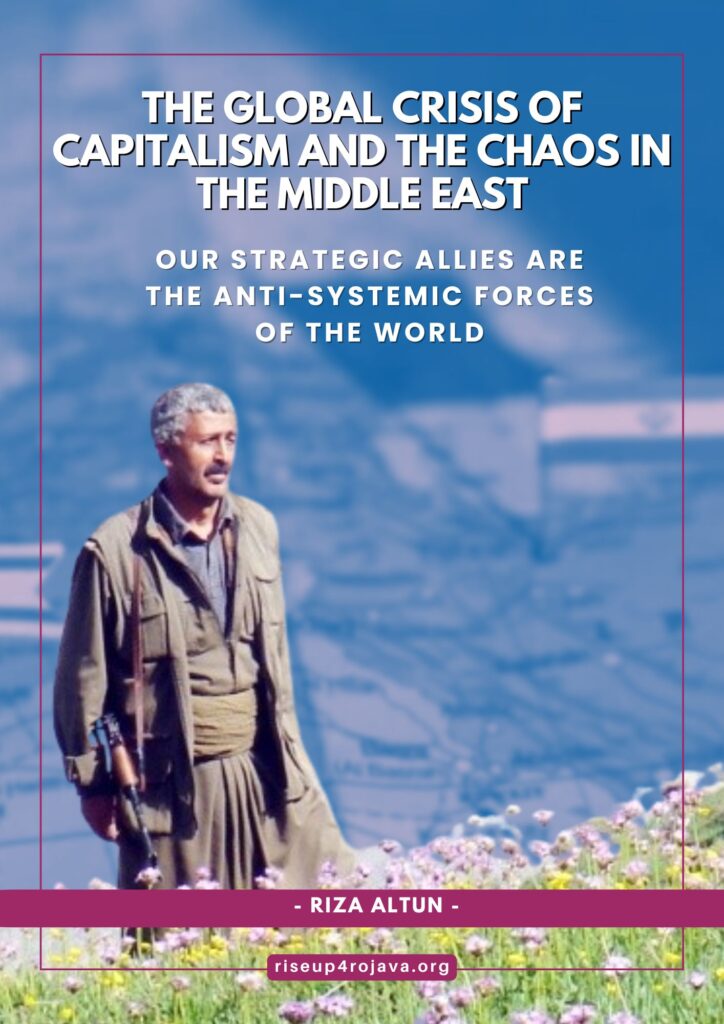
Re-Release: Brochure honoring the life and thought of Riza Altun: “Our strategic allies are the anti-systemic forces of the world.”
“The Global Crisis of Capitalism and the Chaos in the Middle East” — a manual for understanding the reality of the Third World War in the Middle East and around the world. Rıza Altun, founding member of the PKK had fallen on September 25, 2019 due to an Turkish airstrike in the Qandil mountains. We republish this interview not only to commemorate his lifelong struggle for a free life, but because his analysis continues to enlighten our current reality.
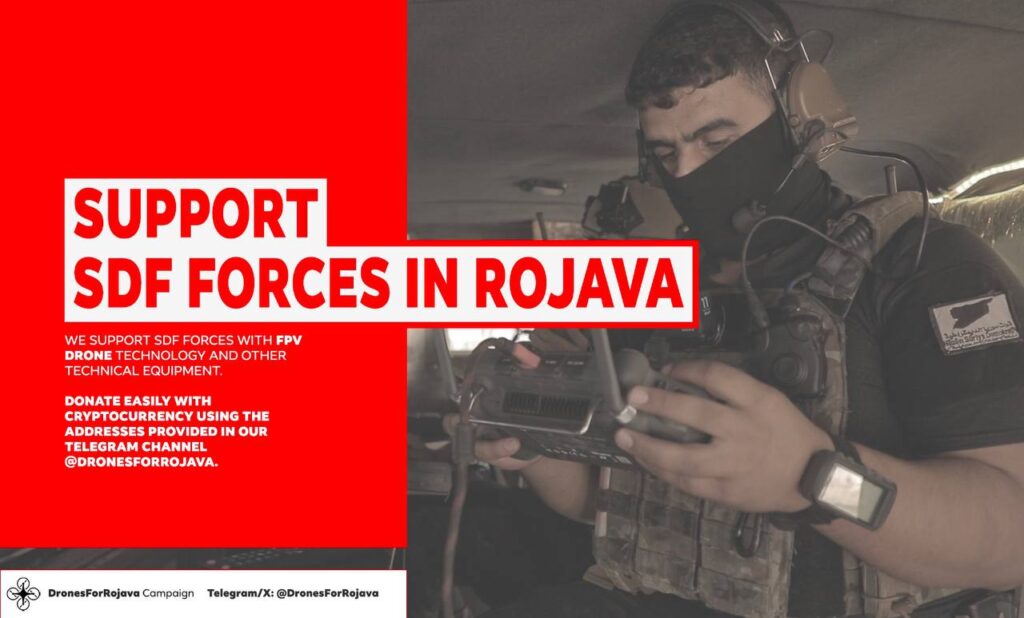
Drones for Rojava: Alliance raises money for armed drones for Rojava
An international alliance wants to support Kurdish units with donations for unmanned weapons systems
26.01.2025
The original interview by Matthias Monroy was published here: https://www.nd-aktuell.de/artikel/1187913.drones-for-rojava-buendnis-sammelt-geld-fuer-bewaffnete-drohnen-fuer-rojava.html (06.01.2025)
Under the name Drones For Rojava, you are collecting money to equip the Syrian Democratic Forces (SDF) with drones. Do you also accept material donations?
We are currently only collecting donations in cryptocurrencies. We also welcome ideas and advice from experts on how to further develop the SDF’s drone combat capabilities. We have communication channels with their representatives to pass on recommendations.
Your campaign does not mention the price of a drone. How much would supporters have to donate for a device?
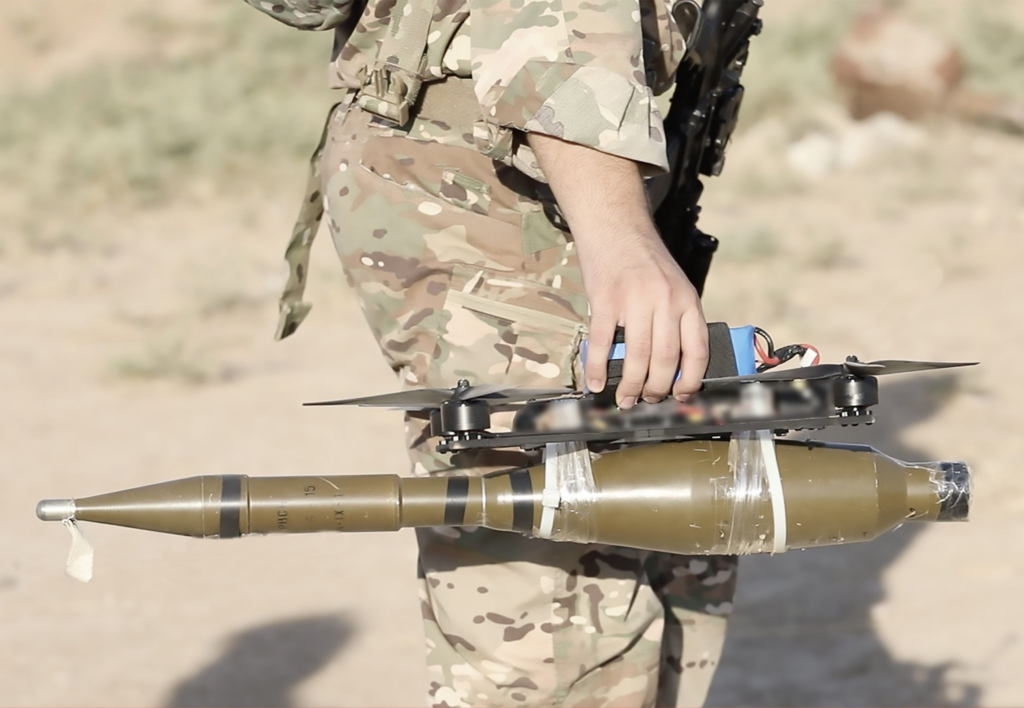
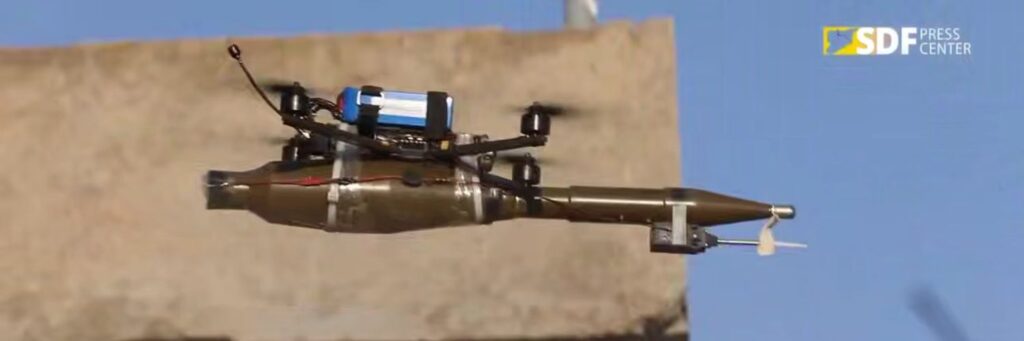
We want to buy drone components and not finished drones. The plan is to procure components from the DJI Mavic series from China as well as components for flight control, servo motors, GPS and telemetry devices, cameras, electronic speed controllers and the like. The drones are to be controlled using the FPV (first-person view) principle, i.e. with video goggles from the perspective of a camera on board.
What kind of weaponry did you have in mind?
We have no relationship with the SDF or other military forces. The drones that are built and the ammunition that is used are therefore not our concern. The SDF also decides which opponents are attacked. We are not involved in the conflict.
You have decided to support the SDF militarily instead of, for example, promoting a peaceful solution to the conflict. Why is that?
The SDF has not started a fight against anyone. But the only peaceful, democratic and inclusive system of government that has been established in Syria is under attack by Turkey and its jihadist militias. The SDF has two options: Resist or surrender. Helping them does not mean advocating war or that we are taking a pro-conflict approach. Of course we want a peaceful solution to the crisis in Syria, but if your country and your democracy are under attack, you must respond. The SDF expresses its willingness for dialog on a daily basis.
I ask this because the left criticizes Israel, the USA, Great Britain and Turkey for drone wars that violate international law. Now you also want to procure drones, albeit smaller ones. How does that go together?
FPV drones are precision weapons. They cannot be compared to large drones that hit targets from high altitude. They literally cannot cause collateral damage or injure civilians unless you do it on purpose. They are also the only legally available piece of hardware that can also be weaponized effectively.
Controlling so-called kamikaze drones is not trivial, especially in the face of enemy air defenses. How were the SDF forces trained?
We have no information of our own about this. However, open sources reveal that their drone units were established in 2015 and the SDF has since invested heavily in this affordable technology. Recent developments show that they have been successful in overcoming enemy air defenses.
Are you an engineer, software developer, aviation enthusiast, or hobbyist? Want to support Rojava?
To what extent are the Islamist militias currently attacking Rojava also using drones?
We are monitoring this closely, but so far the Islamist Syrian National Army (SNA), for example, has not used drones effectively, despite Turkish support. The Islamist militia alliance HTS, on the other hand, appears to have used unmanned aerial vehicles during its offensive against the Assad regime. However, they have focused on kamikaze drones with relatively heavy payloads. We have not identified any effective use of FPV drones in Syria by groups other than the SDF.
Your donation initiative is a reminder that Turkey is no longer on the offensive when it comes to drones. There are reports of large systems such as Anka or Bayraktar TB2 being shot down over Rojava.
We know that the SDF has developed some anti-drone systems that have proven effective against the deadly long-range drones. There are confirmed reports that at least one Turkish Aksungur (the newest and largest drone used by the Turkish military, ed.) and an American Reaper were accidentally shot down in the last month alone. We have no information about the type of weapons used, but we think it is some kind of autonomous loitering munition system that attacks drones at high altitudes.
What is meant by a loitering ammunition system?
Loitering munition is a term for air- or ground-based weapons that are controlled autonomously or by a ground station, usually via a video or GPS link. They perform target search and reconnaissance of enemy ground or air targets on the battlefield and carry a payload to hit this target. Well-known systems are the Iranian Shaheed or Saqhar and the Russian Lancet. However, we have no details on whether or how the SDF use these systems.
You only agreed to the interview if I didn’t ask anything about members of your group. But can you tell me which areas they come from?
We are a group of young people, mostly of Kurdish origin, and some internationalist volunteers, with no connections to any institution or financial support from anyone. We are not a big team. We have aerospace engineering students, software developers and people with different educational backgrounds. Some of us live in Europe, some in Rojava and some in the US. Most of us have never met in person. The only thing that unites us is our patriotism towards the Kurdish cause and our support for the SDF in the face of attacks by NATO’s second largest army and former Al-Qaeda and IS fighters. That is our only motivation.
Translated by the Riseup4Rojava network
26.01.2025
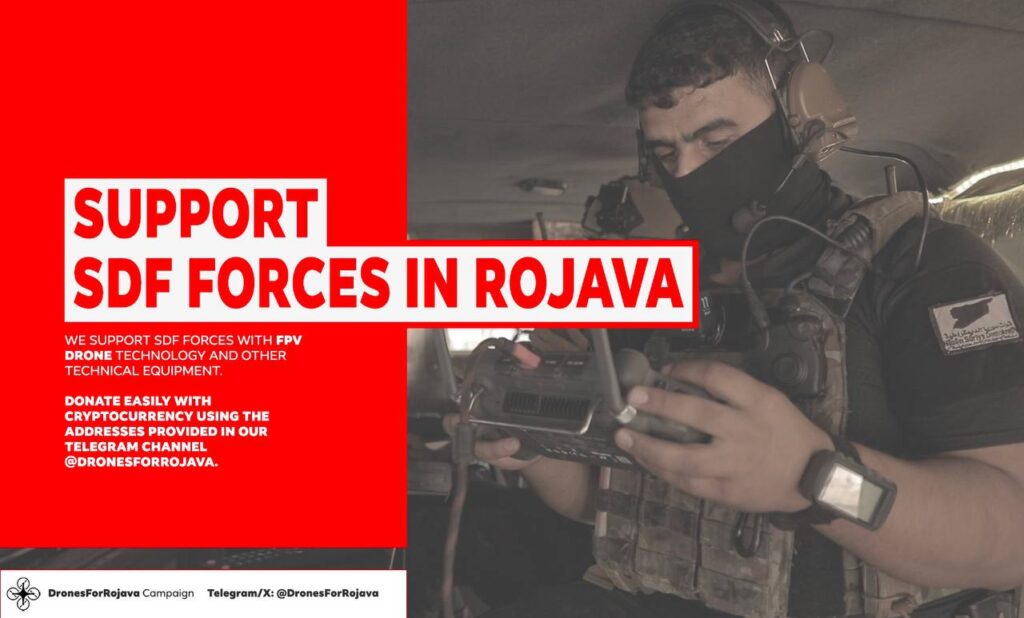
Drones for Rojava: Alliance raises money for armed drones for Rojava
An international alliance wants to support Kurdish units with donations for unmanned weapons systems
26.01.2025
The original interview by Matthias Monroy was published here: https://www.nd-aktuell.de/artikel/1187913.drones-for-rojava-buendnis-sammelt-geld-fuer-bewaffnete-drohnen-fuer-rojava.html (06.01.2025)
Under the name Drones For Rojava, you are collecting money to equip the Syrian Democratic Forces (SDF) with drones. Do you also accept material donations?
We are currently only collecting donations in cryptocurrencies. We also welcome ideas and advice from experts on how to further develop the SDF’s drone combat capabilities. We have communication channels with their representatives to pass on recommendations.
Your campaign does not mention the price of a drone. How much would supporters have to donate for a device?
We want to buy drone components and not finished drones. The plan is to procure components from the DJI Mavic series from China as well as components for flight control, servo motors, GPS and telemetry devices, cameras, electronic speed controllers and the like. The drones are to be controlled using the FPV (first-person view) principle, i.e. with video goggles from the perspective of a camera on board.
What kind of weaponry did you have in mind?
We have no relationship with the SDF or other military forces. The drones that are built and the ammunition that is used are therefore not our concern. The SDF also decides which opponents are attacked. We are not involved in the conflict.
You have decided to support the SDF militarily instead of, for example, promoting a peaceful solution to the conflict. Why is that?
The SDF has not started a fight against anyone. But the only peaceful, democratic and inclusive system of government that has been established in Syria is under attack by Turkey and its jihadist militias. The SDF has two options: Resist or surrender. Helping them does not mean advocating war or that we are taking a pro-conflict approach. Of course we want a peaceful solution to the crisis in Syria, but if your country and your democracy are under attack, you must respond. The SDF expresses its willingness for dialog on a daily basis.
I ask this because the left criticizes Israel, the USA, Great Britain and Turkey for drone wars that violate international law. Now you also want to procure drones, albeit smaller ones. How does that go together?
FPV drones are precision weapons. They cannot be compared to large drones that hit targets from high altitude. They literally cannot cause collateral damage or injure civilians unless you do it on purpose. They are also the only legally available piece of hardware that can also be weaponized effectively.
Controlling so-called kamikaze drones is not trivial, especially in the face of enemy air defenses. How were the SDF forces trained?
We have no information of our own about this. However, open sources reveal that their drone units were established in 2015 and the SDF has since invested heavily in this affordable technology. Recent developments show that they have been successful in overcoming enemy air defenses.
Are you an engineer, software developer, aviation enthusiast, or hobbyist? Want to support Rojava?
To what extent are the Islamist militias currently attacking Rojava also using drones?
We are monitoring this closely, but so far the Islamist Syrian National Army (SNA), for example, has not used drones effectively, despite Turkish support. The Islamist militia alliance HTS, on the other hand, appears to have used unmanned aerial vehicles during its offensive against the Assad regime. However, they have focused on kamikaze drones with relatively heavy payloads. We have not identified any effective use of FPV drones in Syria by groups other than the SDF.
Your donation initiative is a reminder that Turkey is no longer on the offensive when it comes to drones. There are reports of large systems such as Anka or Bayraktar TB2 being shot down over Rojava.
We know that the SDF has developed some anti-drone systems that have proven effective against the deadly long-range drones. There are confirmed reports that at least one Turkish Aksungur (the newest and largest drone used by the Turkish military, ed.) and an American Reaper were accidentally shot down in the last month alone. We have no information about the type of weapons used, but we think it is some kind of autonomous loitering munition system that attacks drones at high altitudes.
What is meant by a loitering ammunition system?
Loitering munition is a term for air- or ground-based weapons that are controlled autonomously or by a ground station, usually via a video or GPS link. They perform target search and reconnaissance of enemy ground or air targets on the battlefield and carry a payload to hit this target. Well-known systems are the Iranian Shaheed or Saqhar and the Russian Lancet. However, we have no details on whether or how the SDF use these systems.
You only agreed to the interview if I didn’t ask anything about members of your group. But can you tell me which areas they come from?
We are a group of young people, mostly of Kurdish origin, and some internationalist volunteers, with no connections to any institution or financial support from anyone. We are not a big team. We have aerospace engineering students, software developers and people with different educational backgrounds. Some of us live in Europe, some in Rojava and some in the US. Most of us have never met in person. The only thing that unites us is our patriotism towards the Kurdish cause and our support for the SDF in the face of attacks by NATO’s second largest army and former Al-Qaeda and IS fighters. That is our only motivation.
Translated by the Riseup4Rojava network
26.01.2025
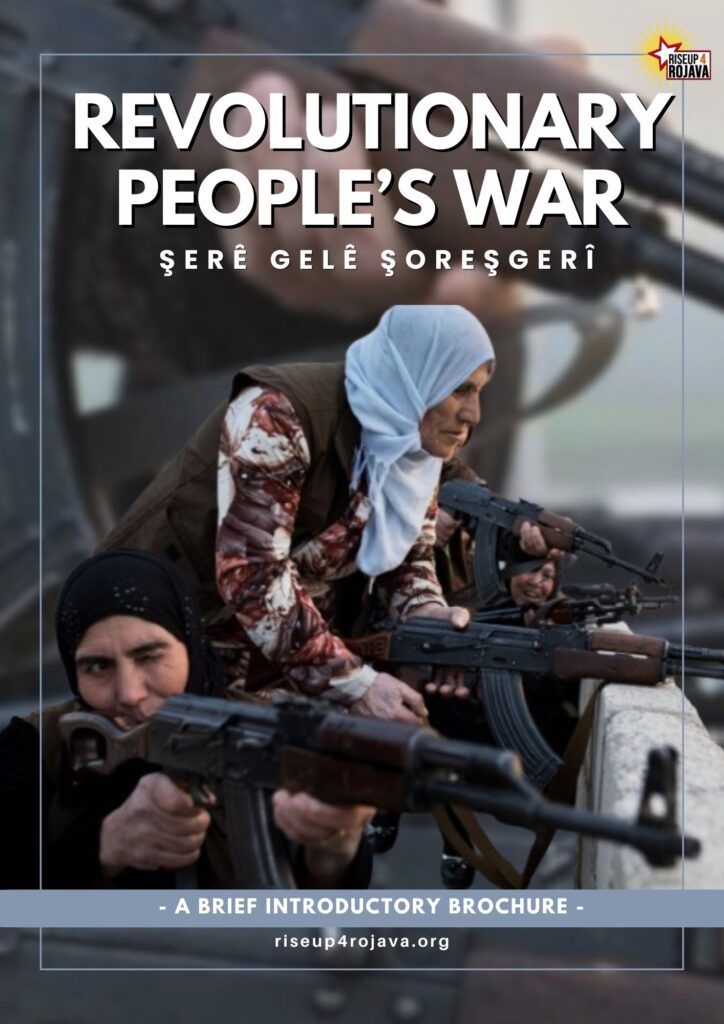
The given text, titled ‘Revolutionary People’s War – Şerê Gelê Şoreşgerî’, is an important introduction to better understand the current strategy of the PKK. This introductory brochure was prepared by the #Riseup4Rojava network, based on transcriptions from an education on the Kurdish Freedom Movement. This introductory brochure is intended to serve as a guide for discussion, education and for better analyses, understanding the current situation we are in around the globe, and for developing a perspective with a practice of what is to be done. With further brief introductory brochures on topics such as Special Warfare, and on Internationalism, the latter text written by Riza Altun, our goal is, on one side, to strengthen the understanding of Democratic Confederalism and the Strategy of Revolutionary People’s War and to deepen strategical discussions in our broader network, and on the other side, to create a strong common perspective of our role, as the global resistance movement, in the defense of the Revolution of Rojava, the smashing of Turkish Fascism, and the build-up of Rojava everywhere.
The urgency for this has become more clearer these days, given the increased attacks onto the Free Mountains of Kurdistan, the revolution of Rojava and the immediate threat for all democratic forces of the world. The importance of understanding the connection between the Free Mountains of Kurdistan and Rojava is also elaborated in the last KCK statement – which includes an evaluation of the current political situation.1 After all, it is an attack on all of us who are part of the global resistance movement.
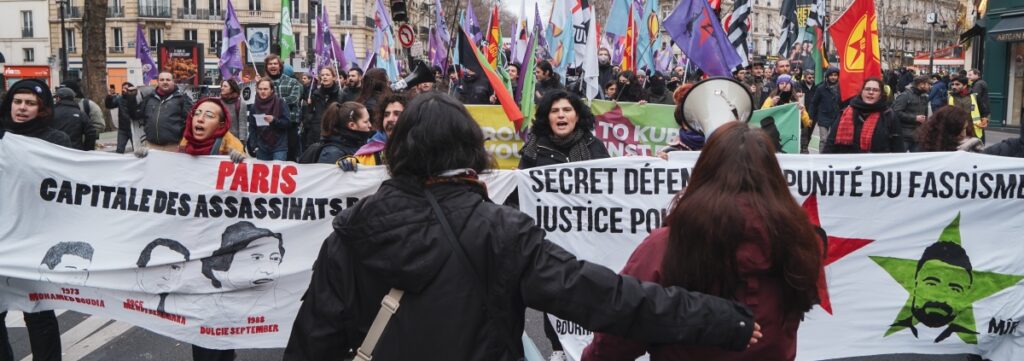
Call for an internationalist bloc for the demonstration in Paris – Against fascism, for justice: internationalist answer
03.01.2025
On January 9, 2013, and December 23, 2022, two attacks struck the heart of Paris. Twice, three Kurdish activists were brutally murdered. On January 9, Sakine Cansiz, Fidan Dogan, and Leyla Saylemez fell victim to a triple femicide carried out by an infiltrated agent of the MIT (Turkish secret services). Nearly ten years later, Evîn Goyî, Mîr Perwer, and Abdurrahman Kizil were assassinated at the Ahmet Kaya Kurdish Cultural Center.
Sakine Cansiz (Sara), alongside Abdullah Öcalan, was one of the seven founding members of the PKK (Kurdistan Workers’ Party, a Kurdish national liberation movement). She was instrumental in establishing the Kurdish women’s army (YJA-Star) and endured torture in Turkish prisons. Fidan Dogan (Rojbîn), a diplomat of the CDK-F (Democratic Kurdish Council in France), was in regular contact with French leftist organizations as well as the French state itself. Leyla Saylemez (Ronahî) was a young activist organized within the youth branch. Like Sakine Cansiz, Evîn Goyî was a pioneer of the women’s revolution. She fought across all four parts of Kurdistan and was injured in Rojava. Mîr Perwer, a renowned singer, had sought refuge in France to sing in his native language. Abdurrahman Kizil had found refuge in the country after fleeing his village, attacked by the Turkish colonial army.
We are fully aware that the Turkish fascist state, through its MIT secret services, is responsible for these two attacks. Investigative journalists have established MIT’s responsibility in the 2013 triple femicide, and many elements strongly suggest at least an inciting role in the 2022 attack. Since then, several assassination attempts or planned actions by the MIT targeting journalists, activists, politicians (including former Kurdish MPs), or Turkish dissidents in exile have been foiled on European soil.
However, in most cases, these actions and intimidations occur with the complicity of Western imperialist states, which consistently conceal or minimize Turkey’s responsibility. This includes successive French governments, which maintain “defense secrecy” over evidence necessary for the judicial investigation into the 2013 triple assassination and refuse to cooperate with Belgian police regarding activities of several men suspected of assassination attempts in Brussels.
While numerous Turkish intelligence agents and informants operate freely on French soil, Kurdish activists are harassed by the authorities and used as bargaining chips with Turkey. A recent investigation by Marianne magazine revealed this dynamic. In 2024 alone, three Kurdish activists were expelled to Turkey, two of whom remain imprisoned there today. Two other activists were placed in detention centers after their political refugee status was revoked. Their expulsions were only prevented through legal actions taken by their lawyers.
At the same time, the French state continues to collaborate with Turkey, maintaining trade and economic relations, and supplying arms and equipment to the Turkish army despite blatant human rights violations in Turkey and the areas it occupies in Syria. The Turkish regime continues to suppress every voice of dissent, seizes Kurdish municipalities, carries out mass imprisonments, and enforces isolation on numerous political prisoners. For example, there was no news of Abdullah Öcalan, imprisoned on an island since 1999, for over the last 44 months until his recent message in October. These inhumane, torturous practices have never been condemned by France, which also keeps Georges Ibrahim Abdallah, a Lebanese communist militant for the Palestinian cause, imprisoned since 1987, despite his eligibility for release since 20 years.
This French collaboration also persists in the face of Turkey’s numerous violations of international law and war crimes through bombings and drone strikes in Iraq and Syria. These attacks target not only PKK guerrilla bases—exercising their legitimate right of armed resistance against colonialism—but also numerous civilian infrastructures and homes. Dozens of villages have been forcibly evacuated by the Turkish army during its attempted invasion of the mountains of Southern Kurdistan (Iraq), while in Rojava, hundreds of thousands of people have been left without electricity, heating, or cooking gas due to the destruction of energy infrastructure. This French collaboration does not surprise us, however. France’s complicity in the ongoing genocide in Gaza has destroyed any credibility it may have had regarding human rights and reveals the true face of imperialism: it is willing to sacrifice entire peoples and the very rules it has established to defend its allies. In the face of this unity among imperialists, it is imperative to build an internationalist and antifascist struggle. For this reason, we invite all political, trade union and associative forces who recognize themselves in this call to mobilize on January 11, 2025, in Paris to join us in forming an internationalist bloc during the demonstration for the six Kurdish comrades assassinated in Paris.
For Sara, Rojbîn, and Ronahî, we cry “Jin Jiyan Azadî!”For Evîn, Mîr, and Abdurrahman, we demand Truth and Justice!For all, we proclaim: “Long live the resistance of the Kurdish people, the Palestinian people, and all the oppressed!”
Young Struggle & Jeunesse Internationaliste, Serhildan Network & Riseup4Rojava
Call for an internationalist bloc for the demonstration in Paris – Against fascism, for justice: internationalist answer
03.01.2025
On January 9, 2013, and December 23, 2022, two attacks struck the heart of Paris. Twice, three Kurdish activists were brutally murdered. On January 9, Sakine Cansiz, Fidan Dogan, and Leyla Saylemez fell victim to a triple femicide carried out by an infiltrated agent of the MIT (Turkish secret services). Nearly ten years later, Evîn Goyî, Mîr Perwer, and Abdurrahman Kizil were assassinated at the Ahmet Kaya Kurdish Cultural Center.
Sakine Cansiz (Sara), alongside Abdullah Öcalan, was one of the seven founding members of the PKK (Kurdistan Workers’ Party, a Kurdish national liberation movement). She was instrumental in establishing the Kurdish women’s army (YJA-Star) and endured torture in Turkish prisons. Fidan Dogan (Rojbîn), a diplomat of the CDK-F (Democratic Kurdish Council in France), was in regular contact with French leftist organizations as well as the French state itself. Leyla Saylemez (Ronahî) was a young activist organized within the youth branch. Like Sakine Cansiz, Evîn Goyî was a pioneer of the women’s revolution. She fought across all four parts of Kurdistan and was injured in Rojava. Mîr Perwer, a renowned singer, had sought refuge in France to sing in his native language. Abdurrahman Kizil had found refuge in the country after fleeing his village, attacked by the Turkish colonial army.
We are fully aware that the Turkish fascist state, through its MIT secret services, is responsible for these two attacks. Investigative journalists have established MIT’s responsibility in the 2013 triple femicide, and many elements strongly suggest at least an inciting role in the 2022 attack. Since then, several assassination attempts or planned actions by the MIT targeting journalists, activists, politicians (including former Kurdish MPs), or Turkish dissidents in exile have been foiled on European soil.
However, in most cases, these actions and intimidations occur with the complicity of Western imperialist states, which consistently conceal or minimize Turkey’s responsibility. This includes successive French governments, which maintain “defense secrecy” over evidence necessary for the judicial investigation into the 2013 triple assassination and refuse to cooperate with Belgian police regarding activities of several men suspected of assassination attempts in Brussels.
While numerous Turkish intelligence agents and informants operate freely on French soil, Kurdish activists are harassed by the authorities and used as bargaining chips with Turkey. A recent investigation by Marianne magazine revealed this dynamic. In 2024 alone, three Kurdish activists were expelled to Turkey, two of whom remain imprisoned there today. Two other activists were placed in detention centers after their political refugee status was revoked. Their expulsions were only prevented through legal actions taken by their lawyers.
At the same time, the French state continues to collaborate with Turkey, maintaining trade and economic relations, and supplying arms and equipment to the Turkish army despite blatant human rights violations in Turkey and the areas it occupies in Syria. The Turkish regime continues to suppress every voice of dissent, seizes Kurdish municipalities, carries out mass imprisonments, and enforces isolation on numerous political prisoners. For example, there was no news of Abdullah Öcalan, imprisoned on an island since 1999, for over the last 44 months until his recent message in October. These inhumane, torturous practices have never been condemned by France, which also keeps Georges Ibrahim Abdallah, a Lebanese communist militant for the Palestinian cause, imprisoned since 1987, despite his eligibility for release since 20 years.
This French collaboration also persists in the face of Turkey’s numerous violations of international law and war crimes through bombings and drone strikes in Iraq and Syria. These attacks target not only PKK guerrilla bases—exercising their legitimate right of armed resistance against colonialism—but also numerous civilian infrastructures and homes. Dozens of villages have been forcibly evacuated by the Turkish army during its attempted invasion of the mountains of Southern Kurdistan (Iraq), while in Rojava, hundreds of thousands of people have been left without electricity, heating, or cooking gas due to the destruction of energy infrastructure. This French collaboration does not surprise us, however. France’s complicity in the ongoing genocide in Gaza has destroyed any credibility it may have had regarding human rights and reveals the true face of imperialism: it is willing to sacrifice entire peoples and the very rules it has established to defend its allies. In the face of this unity among imperialists, it is imperative to build an internationalist and antifascist struggle. For this reason, we invite all political, trade union and associative forces who recognize themselves in this call to mobilize on January 11, 2025, in Paris to join us in forming an internationalist bloc during the demonstration for the six Kurdish comrades assassinated in Paris.
For Sara, Rojbîn, and Ronahî, we cry “Jin Jiyan Azadî!”For Evîn, Mîr, and Abdurrahman, we demand Truth and Justice!For all, we proclaim: “Long live the resistance of the Kurdish people, the Palestinian people, and all the oppressed!”
Young Struggle & Jeunesse Internationaliste, Serhildan Network & Riseup4Rojava
Exclusive Interview with Harûn Apoyî: Revolutionary People’s War – The strategy to defend societies against Capitalism
We met Harûn Apoyî in spring, 2024, in Rojava, North-East Syria to talk about the Strategy of Revolutionary People’s War, the Revolution in Rojava and a perspective for defending societies in face of a comprehensive war waged on them by the states all around the globe.
Harûn Apoyî, born in Kobanê, has been participating in the Rojava Revolution from day one and teaches the concept of Revolutionary People’s war in Academies in all of Rojava and North-East Syria.
RiseUp4Rojava Network 02.01.2025
#Smash Turkish Fascism #Riseup4Rojava
Rojava Verteidigen: Stellt euch den türkischen Angriffen und dschihadistischen Milizen entgegen!
02.12.24
Mitten im anhaltenden Krieg imperialer und islamistischer Kräfte gegen die Völker des Nahen Ostens nutzt die Türkei die Lage aus, um einen der grössten Angriffe auf Rojava und Syrien seit 2019 durchzuführen. Im Rahmen ihres neo-osmanischen Projekts, die Hegemonialmacht in der Region zu werden, zielt der türkische Staat darauf ab, das revolutionäre Rojava zu liquidieren und Syrien weiter zu destabilisieren.
Hayat Tahrir al-Sham (HTS) – ein Ableger von Al-Qaida – und andere Milizen haben ohne grossen Widerstand des syrischen Regimes die Kontrolle über Aleppo übernommen. Gemeinsam mit den HTS-Milizen führen die sogenannte Syrische Nationalarmee (SNA), unterstützt durch türkische Artillerie und Luftangriffe, koordinierte Angriffe auf kurdische Gebiete durch. Diese Gruppen sind keine „Rebellen“, sondern eine Allianz von Dschihadisten mit einer langen Liste von Kriegsverbrechen und Menschenrechtsverletzungen. In den Sozialen Medien tauchen bereits erste Videos von Frauen auf, die in von der SNA eroberten Gebieten entführt wurden.
Die kurdischen Mehrheitsgebiete von Shehba und Tel Rifat sowie die kurdischen Stadtteile Sheikh Maqsoud und Eşrefiye in Aleppo sind eingekesselt und stehen vor einer humanitären Katastrophe.Tausende Vertriebene aus Afrin sowie christliche und andere Minderheiten, die Schutz suchten, sind belagert. Angesichts drohender Massaker werden die Menschen in Shehba und Tel Rifat evakuiert. Sie werden von Kräften bedroht, die massiv von der Türkei und anderen Staaten unterstützt und ausgerüstet werden.
In den letzten zehn Jahren bis heute hat die Region immer wieder Massaker und genozidale Angriffe erlebt, von Shengal 2014 bis hin zum Genozid in Gaza. Die Selbstverteidigungskräfte in Rojava und Nordostsyrien kämpfen, um solche Angriffe zu verhindern und im Falle drohender Massaker die Bevölkerung in Sicherheit zu bringen. Die Menschen in Sheikh Maqsoud haben trotz der Belagerung beschlossen, Widerstand zu leisten. Ganz Rojava ist in Alarmbereitschaft, da Angriffe an weiteren Fronten drohen.
Die imperialistischen Mächte – USA, Türkei und Russland – opfern erneut die Menschen in der Region zugunsten ihrer eigenen Agenda. Doch der Kampfgeist der Rojava-Revolution bleibt ungebrochen. Diese Revolution steht seit über 12 Jahren als Symbol für Hoffnung, Gleichheit, Frauenbefreiung und basisdemokratische Selbstverwaltung. Heute mobilisieren die Menschen in Rojava und die Demokratische Autonome Verwaltung von Nord- und Ostsyrien (DAANES), um diese Aggression abzuwehren und die errungenen Freiheiten zu verteidigen. Die kurdische Bewegung mobilisiert mit ihnen weltweit.
Wir dürfen angesichts dieses Angriffs nicht schweigen. Wir sagen: Es lebe der revolutionäre Volkskrieg! Bijî Şerê Gelê Şoreşgerî!
Wir rufen alle demokratischen, revolutionären und solidarischen Kräfte weltweit auf:
1. Protestiert gegen Institutionen und Profiteure des türkischen Staates.
2. Organisiert Kundgebungen und Aktionen, um auf die Angriffe aufmerksam zu machen und die Komplizenschaft internationaler Mächte, insbesondere die Rolle der Türkei und islamistischer Kräfte, offenzulegen.
3. Folgt unseren Kanälen, bleibt über die Lage informiert und handelt!
Gemeinsam können wir den Widerstand stärken und die Revolution verteidigen, die mit ihrer Parole „Frauen, Leben, Freiheit“ weiterhin Millionen Hoffnung schenkt.
#SmashTurkishFascism – #Riseup4Rojava
Rojava Verteidigen: Stellt euch den türkischen Angriffen und dschihadistischen Milizen entgegen!
02.12.2024
Mitten im anhaltenden Krieg imperialer und islamistischer Kräfte gegen die Völker des Nahen Ostens nutzt die Türkei die Lage aus, um einen der grössten Angriffe auf Rojava und Syrien seit 2019 durchzuführen. Im Rahmen ihres neo-osmanischen Projekts, die Hegemonialmacht in der Region zu werden, zielt der türkische Staat darauf ab, das revolutionäre Rojava zu liquidieren und Syrien weiter zu destabilisieren.
Hayat Tahrir al-Sham (HTS) – ein Ableger von Al-Qaida – und andere Milizen haben ohne grossen Widerstand des syrischen Regimes die Kontrolle über Aleppo übernommen. Gemeinsam mit den HTS-Milizen führen die sogenannte Syrische Nationalarmee (SNA), unterstützt durch türkische Artillerie und Luftangriffe, koordinierte Angriffe auf kurdische Gebiete durch. Diese Gruppen sind keine „Rebellen“, sondern eine Allianz von Dschihadisten mit einer langen Liste von Kriegsverbrechen und Menschenrechtsverletzungen. In den Sozialen Medien tauchen bereits erste Videos von Frauen auf, die in von der SNA eroberten Gebieten entführt wurden.
Die kurdischen Mehrheitsgebiete von Shehba und Tel Rifat sowie die kurdischen Stadtteile Sheikh Maqsoud und Eşrefiye in Aleppo sind eingekesselt und stehen vor einer humanitären Katastrophe.Tausende Vertriebene aus Afrin sowie christliche und andere Minderheiten, die Schutz suchten, sind belagert. Angesichts drohender Massaker werden die Menschen in Shehba und Tel Rifat evakuiert. Sie werden von Kräften bedroht, die massiv von der Türkei und anderen Staaten unterstützt und ausgerüstet werden.
In den letzten zehn Jahren bis heute hat die Region immer wieder Massaker und genozidale Angriffe erlebt, von Shengal 2014 bis hin zum Genozid in Gaza. Die Selbstverteidigungskräfte in Rojava und Nordostsyrien kämpfen, um solche Angriffe zu verhindern und im Falle drohender Massaker die Bevölkerung in Sicherheit zu bringen. Die Menschen in Sheikh Maqsoud haben trotz der Belagerung beschlossen, Widerstand zu leisten. Ganz Rojava ist in Alarmbereitschaft, da Angriffe an weiteren Fronten drohen.
Die imperialistischen Mächte – USA, Türkei und Russland – opfern erneut die Menschen in der Region zugunsten ihrer eigenen Agenda. Doch der Kampfgeist der Rojava-Revolution bleibt ungebrochen. Diese Revolution steht seit über 12 Jahren als Symbol für Hoffnung, Gleichheit, Frauenbefreiung und basisdemokratische Selbstverwaltung. Heute mobilisieren die Menschen in Rojava und die Demokratische Autonome Verwaltung von Nord- und Ostsyrien (DAANES), um diese Aggression abzuwehren und die errungenen Freiheiten zu verteidigen. Die kurdische Bewegung mobilisiert mit ihnen weltweit.
Wir dürfen angesichts dieses Angriffs nicht schweigen. Wir sagen: Es lebe der revolutionäre Volkskrieg! Bijî Şerê Gelê Şoreşgerî!
Wir rufen alle demokratischen, revolutionären und solidarischen Kräfte weltweit auf:
1. Protestiert gegen Institutionen und Profiteure des türkischen Staates.
2. Organisiert Kundgebungen und Aktionen, um auf die Angriffe aufmerksam zu machen und die Komplizenschaft internationaler Mächte, insbesondere die Rolle der Türkei und islamistischer Kräfte, offenzulegen.
3. Folgt unseren Kanälen, bleibt über die Lage informiert und handelt!
Gemeinsam können wir den Widerstand stärken und die Revolution verteidigen, die mit ihrer Parole „Frauen, Leben, Freiheit“ weiterhin Millionen Hoffnung schenkt.